
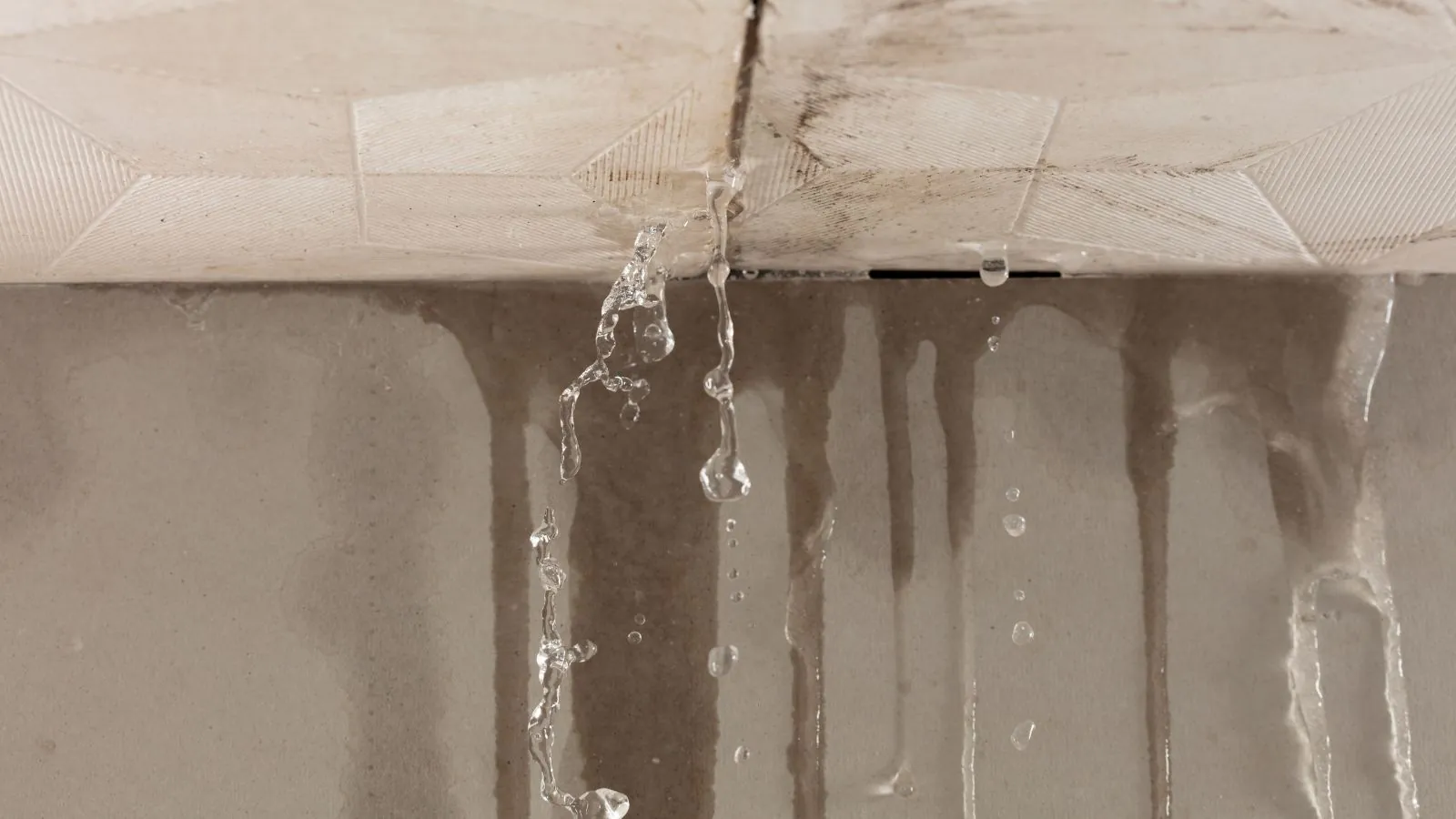
The most common signs of water damage are stains on ceilings and walls, paint that bubbles or peels, floors that cup or buckle, a musty odor, warped baseboards, and a water bill that climbs with no change in how you use water. One sign is a reason to look closer. Two or three together usually mean moisture is present.
Below, each sign is matched to the most likely source and a next step. Use it as a way to decide how fast to act, not as a diagnosis.
Why a house shows damage late
Water hides. It runs along joists, drips inside wall cavities and soaks into insulation, subflooring and the back side of drywall. By the time a stain appears on the surface, the material behind it has often been wet for days or longer.
That delay is why early signs matter. A faint ring on a ceiling, a paint blister near a window or a floor board that lifts at the edge are the visible end of something that has been happening out of sight. Check the room above and the wall behind the sign, not only the spot itself.
Also look at timing. A stain that appears after a storm points to the roof, a window or an exterior wall. A stain that grows during dry weather points to plumbing, an appliance or condensation. Writing down when each sign first showed up helps whoever inspects the problem.
Signs on ceilings and walls
Brown or yellow rings on a ceiling are the classic sign. Rings that spread outward over several days suggest an active leak, while a dry, well-defined ring may be old. Touch it. A soft, cool or sagging spot is wet right now, and you should keep people and furniture out from under it.
On walls, watch for paint that bubbles, peels or turns chalky, wallpaper seams that lift, baseboards that swell and drywall that feels soft or crumbles at the bottom edge. Streaks that run down from a window or a ceiling corner suggest water entering from above.
If a ceiling is stained or sagging, the question is what is above it. A bathroom, a roof penetration, an attic duct and a supply line can all do this. The ceiling water damage repair page explains how the cause is traced before anyone cuts into the drywall.
Spotted a sign you cannot explain?
Call (732) 352-9660 and describe it. We respond the same day when a crew is available.
Signs in floors
Wood and laminate flooring tell you a lot. Cupping, where board edges rise higher than the centers, usually means moisture is coming from below or has soaked in unevenly. Crowning is the opposite, with the center higher. Gaps that open and close with the season are normal, but boards that lift, stain or feel spongy are not.
Carpet may feel damp, smell musty or show dark patches along the edges. Tile can crack or loosen when the substrate swells. Any floor that is warm in one spot in winter, with no heating line under it, deserves attention.
If wood floors have started to cup, read how a crew approaches hardwood floor water damage repair. The sooner the source is found and dried, the more options remain, because boards that are dried early can sometimes settle back, while boards that stay wet may need replacing.
Sign, likely source and next step
This table pairs signs you can see or hear with where they often come from and what a sensible response is. Treat the source column as a list of possibilities.
| Sign | Likely source | Next step |
|---|---|---|
| Brown ring on ceiling, still growing | Roof leak, bathroom above, supply or drain line | Keep people out from under it, check what is above, call a crew |
| Bubbling or peeling paint on a wall | Moisture behind the wall, window leak, plumbing | Press gently, check the other side of the wall, note the date |
| Cupped or buckled wood floor | Leak from below, appliance, high humidity | Find and stop the source, then have moisture measured |
| Musty odor with no visible cause | Hidden damp in a wall, floor or crawl space | Check cabinets, closets and exterior walls, then get readings |
| Warm spot on slab floor | Possible hot-water line leak under the slab | Check the water meter for movement, then call |
| Water bill rises, usage unchanged | Leaking toilet, line or fixture | Read the meter with all fixtures off, check for movement |
| Swollen baseboards or trim | Water at the wall base | Look for a plumbing fixture or exterior grading cause |
| Sound of running water, no tap on | Active leak in a wall or under a floor | Shut the main valve if you can and call |
None of these signs proves a cause. They tell you how soon to bring in a person with a moisture meter.
Odor, spots and the bill
A musty odor in a closet, cabinet or basement corner is a prompt to look for a damp surface. Check the back of cabinets, the wall behind a toilet, the base of an exterior wall and the underside of a sink. Odor alone does not tell you what is growing or how much, so use it as a reason to measure, not to guess.
Black, green or gray spots on a wall or ceiling near a moisture source can be mold or dirt. Do not scrub them dry until you know the moisture source is stopped. Mold needs moisture, and cleaning without fixing the water usually leads to a repeat.
A rising water bill can also point to a hidden leak. Marlboro's water comes from the Marlboro Township Water Utility. With every tap and appliance off, look at your meter or the dial that spins. If it keeps moving, water is going somewhere, and that is the moment to look at toilets first, then call about a possible slab leak or line leak.
What Marlboro homeowners should know
NOAA's 1991 to 2020 climate normals for the Freehold-Marlboro station (USC00283181) show 48.57 inches of precipitation in an average year. That is a lot of water landing on roofs, flashings, window frames and grading every year, which is a reason to check those spots after a heavy storm.
The same normals record an average of 106 days a year with a low at or below 32 degrees Fahrenheit, with the last spring freeze around April 17 and the first fall freeze around October 23. A pipe in an exterior wall or an unheated space is exposed to that cold on many days, so a damp spot that shows up in late winter may trace to a pipe that froze and then thawed.
These numbers describe climate, not how many homes have leaks. Use them as a calendar: check the roof and gutters after wet seasons and look for pipe trouble after hard freezes.
Signs by season
In winter, look for new stains on exterior walls and ceilings after a thaw, plus any room that suddenly smells damp. A pipe that split during a freeze may not leak until temperatures rise. If a stain appears just after a cold snap, mention that when you call.
In spring and fall, heavy rain raises the odds of roof, window and foundation seepage. Check ceilings below roof valleys, the corners of basement walls and the base of garage walls. Bubbling paint on an exterior-facing wall after a storm points to moisture coming from outside.
In summer, air conditioning adds condensation. A stain under an attic air handler or a wet drip pan is a common summer sign. Warm humid air hitting cold ducts can also leave water on ceilings, even with no pipe leak at all.
When a sign means call now
Some signs call for action the same day, not a note on a to-do list. If you see any of these, stop the source if you safely can and call (732) 352-9660.
- A ceiling that sags, bulges or drips
- Water near outlets, switches, light fixtures or the electrical panel (stay out, cut power only if the panel is dry and safe to reach, and call 911 or the utility for any electrical or gas risk first)
- Sewage smell with water at a floor drain
- A water meter that keeps moving with everything off
- Wet carpet or drywall that has been damp for more than a short time
How to document what you see
Take dated photos of each sign with a coin or tape measure for scale. Mark the edge of a stain lightly with a pencil and note the date, so you can see whether it grows. Record the meter reading at night and again in the morning if you suspect a hidden leak.
Hand that record to the person who inspects the house. We serve homes in Colts Neck and Freehold as well as Marlboro, and the first questions are the same everywhere: where is it, when did it start and has it changed. Call (732) 352-9660 and we respond the same day when a crew is available.
Questions about spotting water damage
Press it and look at the edges. A stain that is soft, cool or has a damp, darker rim is likely active. A dry, hard stain with a crisp ring may be old. Mark the edge with a pencil and check again after the next rain or after using the bathroom above. If it grows, call for an inspection.
Cupping means the bottom of the board holds more moisture than the top. Sources include a slow leak below, an appliance line, a wet crawl space or basement, and long periods of high humidity. A meter reading from the floor, subfloor and air will show which one fits.
Not always, but it is a reason to look. A damp odor often comes from moisture trapped in a wall, a closet, a rug or a basement corner. Check for stains, softness and recent leaks, and get a moisture reading if you cannot find the source.
Turn off every tap, appliance and ice maker, then look at the meter or its leak dial. If it keeps moving, water is leaving the system somewhere. Check toilets first by adding a few drops of food coloring to the tank. If the color shows up in the bowl without flushing, the flapper is leaking.
Not until the source is fixed and the material is measured dry. Paint over a damp surface hides the sign and can trap moisture. Stain-blocking primer does not fix a leak. Wait for readings, then repair and paint.
The NOAA normals for the Freehold-Marlboro station show 48.57 inches of precipitation a year and 106 days at or below freezing. Those numbers support checking roofs and exposed pipes, but they do not say how many local homes have leaks. Use them to time your own checks.
Small signs, early answers
Call (732) 352-9660 to have moisture measured before a small leak becomes a rebuild.