
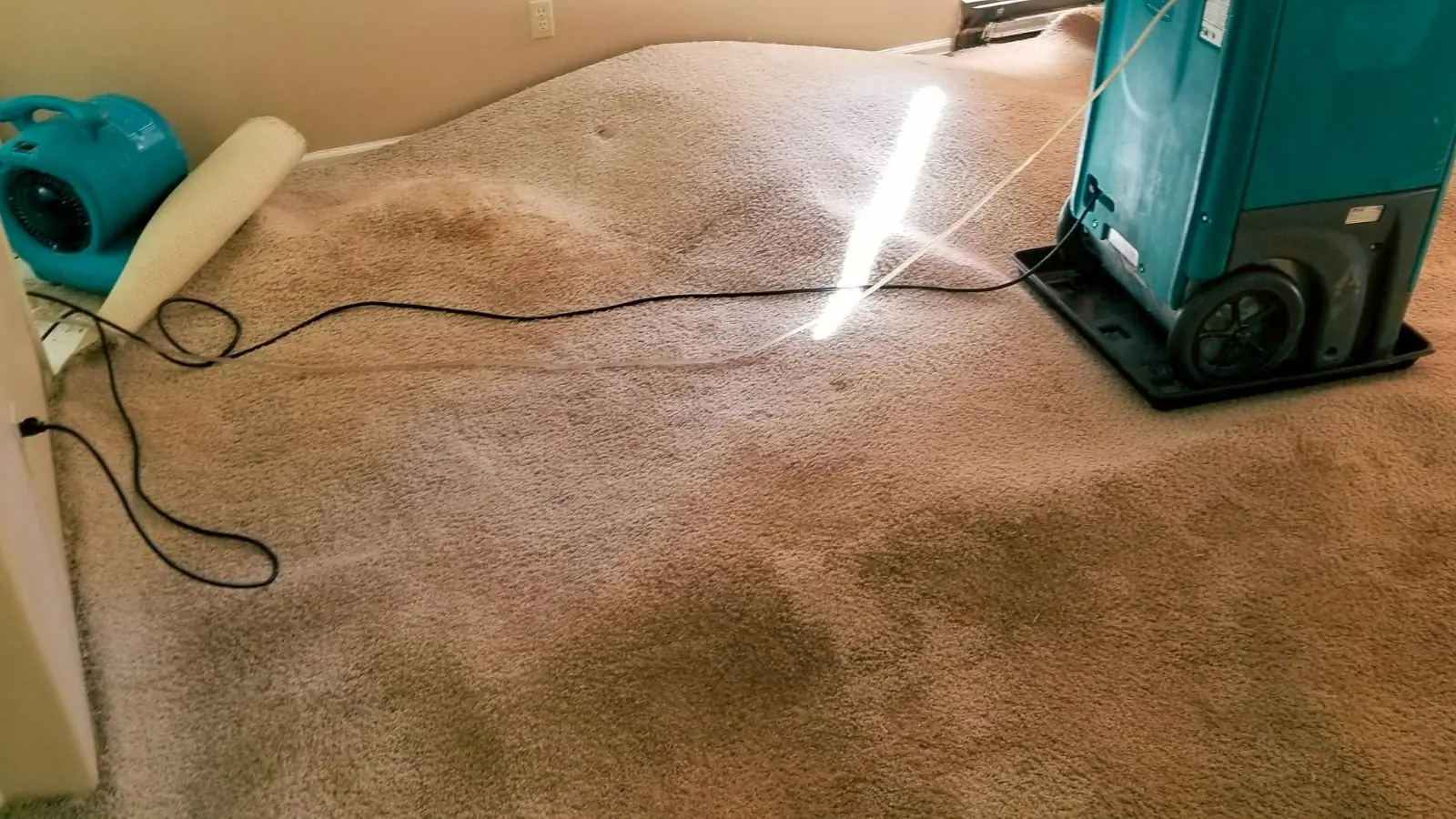
Carpet water damage is the soaking of carpet fibers, backing and the foam or fiber pad beneath them. The pad acts like a sponge, holding gallons of water long after the carpet surface feels almost dry. Whether the carpet is saved or discarded depends mostly on one thing: what kind of water it was.
Clean-water carpet is often saved by fast water extraction and drying. Contaminated carpet is removed. This page shows how that decision is made, step by step.
Category 1, 2 or 3: how the water type decides the carpet
Restoration standards (ANSI/IICRC S500) sort water into three categories. Category 1 comes from a clean source, Category 2 carries some contamination, and Category 3 is grossly contaminated. The same carpet may be saved or discarded depending on which category it met, and the category can worsen with time.
The table is the decision framework we use on the first visit.
| Category | Typical source | Carpet | Pad |
|---|---|---|---|
| 1 (clean) | Supply line, sink overflow, ice maker line | Usually dried in place or lifted and dried | Often replaced, since it holds water and dries slowly |
| 2 (gray) | Washer or dishwasher discharge, sump overflow, aged Category 1 | Cleaned and dried if treated quickly, discarded if it has sat | Replaced |
| 3 (black) | Sewage, rising flood water, a toilet backing up | Removed and discarded | Removed and discarded |
A Category 1 spill left wet for a day or two can drift into Category 2 as microbes grow, which is why speed matters.
What a soaked carpet looks and smells like
A wet carpet makes a squishing sound underfoot and darkens in patches. The pad underneath is often wetter than the surface, so you can have a dry-looking carpet with a soaked cushion.
These signs tell you the water has reached the pad or subfloor:
- A musty smell that returns when the room warms up
- Water squeezing out when you press the carpet with a heel
- Carpet edges pulling away from baseboards or tack strips
- Rust-colored stains or stains that wick up from below
- Rippling or bubbling where the backing has separated
Press on the carpet near a wall and near the lowest spot in the room. Those readings help us locate the wettest area before we meter it.
Carpet still squishing?
Call (732) 352-9660 and tell us what the water was, and we will sort salvage from replacement.
Can wet carpet be saved? The honest salvage rules
Carpet fiber itself handles water well. The risks are the backing, the pad, the subfloor and any contamination. Clean-water carpet with a sound backing that is caught within a day or two can usually be extracted, cleaned and dried in place, often with the pad replaced.
Carpet that is stained by gray water, has sat wet for several days, or has a separated backing is generally replaced. Wool and delicate rugs are judged individually. If a carpet cannot be dried quickly, mold can start to grow within a day or two of damp conditions, so waiting to see what happens costs more than it saves.
How we extract and dry carpet
Extraction uses weighted tools or truck-mounted equipment to pull water through the carpet and the pad. In a clean-water loss, the carpet may be lifted from the tack strips, the pad removed or dried, and an air mover set under the carpet to dry the underside. An LGR dehumidifier then lowers humidity in the room.
The subfloor gets metered too, because water that soaks through the pad ends up in the plywood or slab below. Our structural drying process logs these readings daily, and the carpet is reset and restretched only after the floor beneath it is dry.
When the water is raw sewage
Carpet that touches sewage water cannot be sanitized, and the area should be treated as contaminated. Stay out of it, keep children and pets away, and call 911 or the utility for any electrical or gas risk before calling us.
- Do not walk through or vacuum the area, which spreads contamination.
- Cut power only if the panel is dry and safe to reach.
- Keep wet shoes and hands away from clean rooms.
- See our sewage backup cleanup page for the full process, including what is removed and how the space is sanitized.
Replace the pad, restretch or pull the carpet
Three outcomes come out of a carpet job. In the first, carpet and pad are dried in place, which is the least invasive but works only for clean, recent water. In the second, the carpet is lifted and the pad replaced, then the carpet is restretched, a common result for Category 1 and some Category 2 losses.
In the third, the carpet is removed and replaced. Removal costs more but is the right call for contaminated water, a long soak, a delaminated backing or a wet subfloor. A carpet installer can restretch and seam the dried carpet, and we will tell you which route your floor falls under before the work starts.
What drives the cost of carpet water damage work
Scope and price are explained before work starts, and these factors move the number:
- Water category: a clean-water carpet can be dried while contaminated carpet must go.
- Affected square footage and number of rooms.
- Materials involved: carpet type, pad, tack strips and subfloor.
- Drying days and equipment, including air movers under lifted carpet.
- Rebuild scope: new pad, restretching, seaming or full carpet replacement.
Sudden and accidental water is often covered by homeowners insurance, gradual leaks and neglect often are not, and flood damage is usually excluded and needs separate flood coverage. Check your policy and ask your insurer. Call (732) 352-9660 to get a real number.
Carpeted basements and bedrooms in Marlboro
Rain and frost both feed carpet losses. NOAA's Freehold-Marlboro station records 48.57 inches of precipitation a year (1991 to 2020 normals), and a finished space with carpet over a slab is where a seep or a sump failure shows up. The township stormwater code, Sec. 295-24, exempts uncontaminated sump pump discharge from the storm-sewer ban, so a sump that runs is allowed but a pump that fails can flood the carpet below.
Wherever you live, the sorting step is the same, and a crew in Freehold or Marlboro asks the same first questions: what the water was, how long it sat, and how deep it went. Photograph the room before anything is moved.
Carpet questions after a flood or leak
Often, yes, if the water was clean and drying starts within a day or two. The carpet is extracted, lifted if needed and dried, and the pad is usually replaced. Carpet touched by sewage or old, sitting water is generally discarded.
There is no single number, because it depends on the water category and the room conditions. As a rule, the longer carpet stays wet, the more likely it becomes a replacement, and damp conditions can lead to mold in a day or two. The fastest way to find out is to call and describe the water.
In most cases, yes. The pad absorbs water, dries slowly and can hold contamination, so replacing it is cheaper than trying to dry it. Sometimes a lightly wetted pad can be dried in place, and readings tell us.
Category 1 water comes from a clean source such as a supply line. Category 2 carries some contamination, like washer discharge. Category 3 includes sewage and flood water. If you are not sure, call us and describe the source, and treat it as contaminated until we have looked.
Fans can help a damp spot, but they cannot dry the pad and subfloor underneath, and a wet pad can stay wet for weeks. We do not rent equipment. For anything larger than a small spill, a metered dry-out finds what fans leave behind.
It depends on the cause. Sudden and accidental water damage is often covered, gradual leaks and neglect often are not, and flood is usually excluded and needs separate flood coverage. Check your policy and ask your insurer. We cannot promise an outcome.
Save the carpet you can, remove the rest
Call (732) 352-9660 for same-day response when available and a scope explained before work starts.