
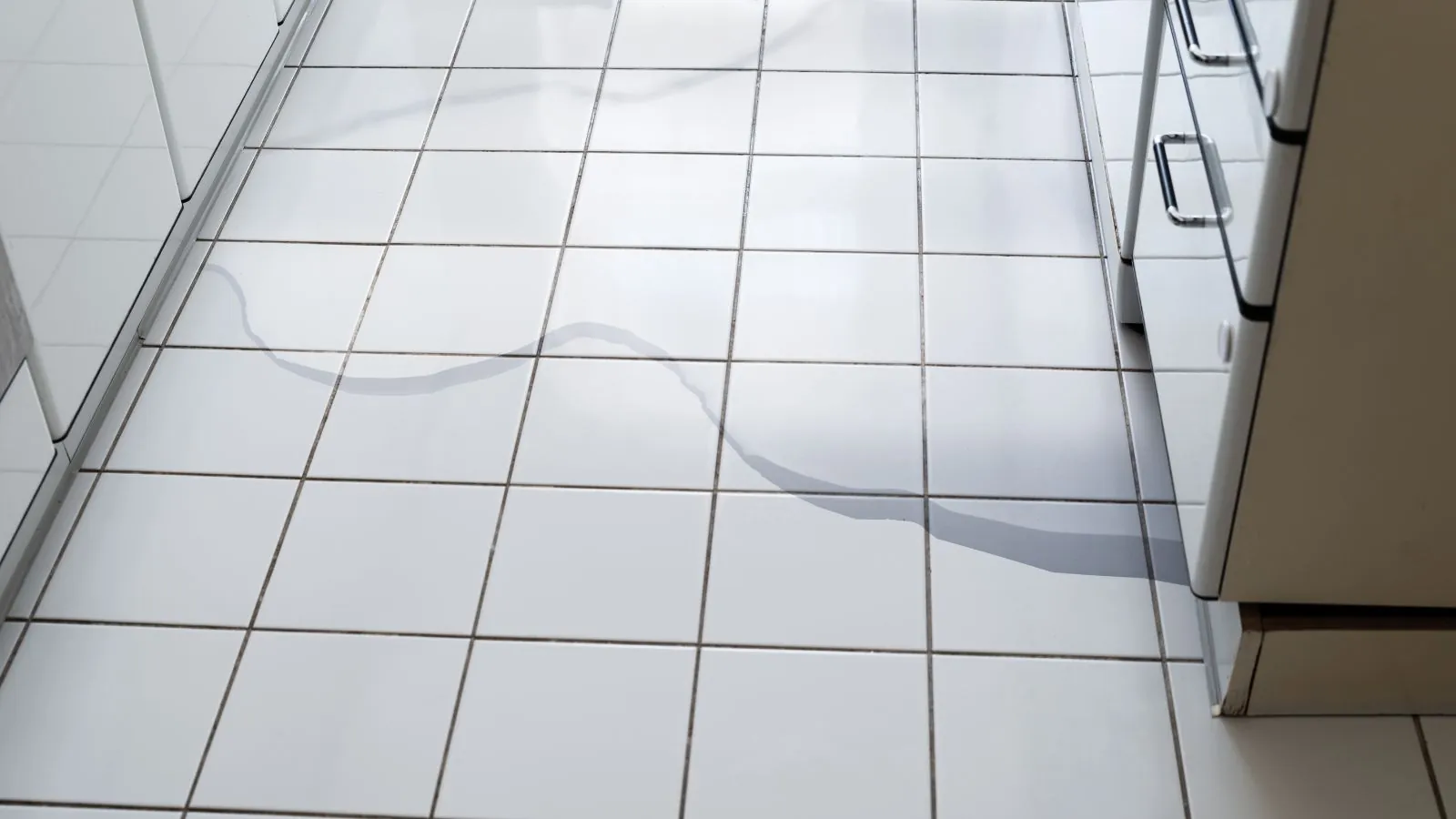
A split washer hose, a failed dishwasher drain or a cracked refrigerator supply line can put gallons across a floor in minutes. Appliance leak water damage is the wet flooring, wall and cabinet material left after a supply or drain failure on a household appliance. Our Marlboro crews answer the line around the clock.
While you wait, close the appliance shutoff or the main valve, unplug the unit only if the floor around the outlet is dry, and lift everything off the wet floor. If the water reached the sink base, the work overlaps with kitchen water damage restoration.
Washer, dishwasher or fridge leaking right now
Appliance failures fall into two types. A supply failure means pressurized water, so a burst washer hose or a cracked ice maker line keeps pouring until someone closes a valve. A drain failure only leaks while the machine cycles, which is why a loose washer standpipe or a clogged dishwasher drain can drip for weeks before a stain shows up.
Call the restoration line the moment water is moving past the footprint of the appliance. Tell the dispatcher which machine it is, what the floor is made of, and whether water is coming through a ceiling below. Same-day response is offered when a crew is available, and the line is staffed overnight.
What to do while help is on the way
These five actions, in this order, limit how much the floor and cabinets absorb before our extraction units arrive.
Close the valve
Turn the shutoff behind the washer or under the sink clockwise. If it spins loose or will not stop the flow, close the main water valve where the line enters the house.
Stop the cycle
Press cancel on the control panel. Do not open a front-loading washer door while it is full of water.
Check the outlet first
Unplug the appliance only if the floor around the plug is dry. If water touches the outlet, leave the cord alone and read the safety panel below.
Clear the floor
Pick up rugs, laundry baskets, shoes and boxes. Set furniture legs on foil or plastic blocks so the finish does not stain.
Photograph, then call
Take wide and close photos of the appliance, the valve and the wet area for your insurer, then call (732) 352-9660.
Machine stopped, floor still wet?
Call (732) 352-9660, tell us the appliance and the flooring, and we will tell you what to do before the crew arrives.
Water near the plug, the panel or a gas dryer
Laundry rooms and kitchens put receptacles, breakers and sometimes gas lines within a few feet of the leak. If water is standing near an outlet, a power strip or the panel, stay out of the room. Cut power at the breaker only if the panel is dry and you can reach it without stepping in water.
Call 911 or the utility for any electrical or gas risk before calling the restoration line. Drying starts only after the power question is settled.
- Do not touch a wet cord, plug or extension strip.
- Do not run a household vacuum on standing water.
- Keep children and pets out of the room until the floor is dry or covered.
- If you smell gas near a dryer or range, leave the house and call from outside.
Where appliance water goes after it leaves the floor
Water does not stay where it lands. It crosses vinyl seams, wicks into the bottom of baseboards, and drops through gaps around the drain pipe into the subfloor or the ceiling below a second-floor laundry. Signs show up later as a musty smell, peeling vinyl corners, buckled laminate and a brown ring on the ceiling under the washer.
Moisture meters read the wood and drywall directly, and a thermal imaging camera shows cold, wet zones behind a toe kick without cutting anything open. On carpet, the pad holds water long after the surface feels dry, so carpet water damage restoration starts by lifting a corner and testing the pad and tack strip.
Failure points compared by appliance
Each appliance fails in its own way, and the failure tells us which materials to check first. This table is the quick version we run through on the phone.
| Appliance | Typical failure | How it shows up | First place we check |
|---|---|---|---|
| Washer | Braided supply hose or shutoff valve | Steady flow or spray behind the machine | Subfloor and wall base behind the unit |
| Washer (upstairs) | Drain standpipe overflow | Ceiling stain or drip in the room below | Ceiling drywall and light fixtures |
| Dishwasher | Door gasket, inlet valve or drain hose | Water at the toe kick or warped floor edge | Cabinet base and flooring under the unit |
| Refrigerator | Ice maker line or water filter fitting | Damp floor in front, swollen cabinet side | Floor under the fridge and adjacent cabinets |
A water filter fitting that weeps slowly is the hardest of these to catch, because the wet area sits under a refrigerator that nobody moves.
A washer valve break on a hardwood hallway
A common call goes like this. The washer valve gave way overnight, the hallway hardwood is already lifting at the board edges, and the homeowner wants to know if the floor can be saved. Hardwood takes on water from the seams and the underside, so cupping starts within days, and the first move is getting the surface and the cavity beneath it drying at once.
We set directional air movers, run an LGR dehumidifier, and record the moisture content of sample boards each visit until the readings flatten. Boards that dry flat can often be sanded and refinished, while boards that stay cupped come out, which is covered in hardwood floor water damage repair. Replacing too early wastes money, and waiting too long invites mold.
How the extraction and drying work runs
Extraction comes first. A portable extraction unit pulls standing water from hard floors and carpet, and a squeegee tool clears the corners. Clean supply water from a washer hose is Category 1 on arrival, but it can slip to Category 2 within a day or two, and dishwasher drain water starts closer to Category 2.
Then the drying equipment goes in. Air movers push dry air across wet surfaces, a dehumidifier pulls moisture out of the room, and small holes are drilled behind toe kicks to dry the cavity. We follow ANSI/IICRC S500, the published standard for water damage restoration, and you can ask any company whether its crews do. Clean-water jobs on hard surfaces often finish in three to five days.
What drives the cost of an appliance leak
Two leaks from the same model of washer can land in very different places, so the quote follows the scope: what got wet, how deep, and for how long. The price is explained before any work begins.
- Water category: clean supply water costs less to handle than gray drain water from a dishwasher or washer pump.
- Affected area: a kitchen corner and an open basement-stair laundry room differ in square footage and in how many wet materials sit side by side.
- Flooring and cabinet materials: tile dries quickly, while hardwood, laminate and particleboard toe kicks need slower, monitored drying or replacement.
- Drying days and equipment: the number of air movers and dehumidifiers and the days they run set most of the mitigation line.
- Rebuild scope: baseboard, drywall and cabinet repair are separate from the drying itself.
Sudden and accidental water damage, such as a hose that bursts, is often covered by a homeowners policy, while a leak that dripped for months is often treated as maintenance. Check your policy or ask your insurer. For a real number on your floor, call (732) 352-9660.
Appliance leaks in Marlboro homes
Marlboro has 14,716 housing units, and 93.1 percent are owner-occupied, so most appliance leaks here are the homeowner's to report and repair. Keep the burst hose or failed valve if you can, since your insurer may ask to see it.
If you cannot close the main at your own house, the Marlboro Township Water Utility directs off-hours water emergencies to township police. For help drying the floor, our crews work out of 184 Route 9, and a nearby crew in Freehold covers the neighboring side of the township line.
Appliance leak questions from Marlboro callers
Yes. The line is staffed around the clock, so a washer hose that lets go on a Sunday evening gets answered right away. Tell us the appliance, the floor type and whether water is dripping into a room below. Same-day response is offered when a crew is available, and no arrival time is promised before the situation is clear.
Sudden and accidental water damage is often covered, while damage from a slow drip that went unrepaired often is not. The answer depends on your policy language and deductible. Photograph everything, keep the failed part, and ask your insurer what it needs. We explain the scope of work in plain terms so your adjuster can compare.
Look for a soft or lifting floor edge, a swollen cabinet side, a musty smell when the door opens, or a floor that feels cool compared with the rest of the room. A moisture meter confirms it in minutes, and a thermal camera can trace the wet area without pulling the appliance out.
Close the valve and leave the repair for later. A new hose can wait, and a wet floor cannot. Once the area is dry, replace rubber washer hoses with braided stainless versions and check the old hose's date stamp. A plumber can handle a stuck shutoff valve.
Clean-water leaks on tile or sealed vinyl often dry in about three days. Hardwood, laminate and cabinet bases can take longer because the material releases moisture slowly. We read the moisture content each visit and stop only when the readings match an unaffected reference area, not when the surface feels dry.
Not always. Boards that are caught early and dried under controlled conditions often flatten, and a sanding and refinish brings the surface back. Boards that stay cupped or have started to crack at the edges usually come out. We tell you which category your floor is in once the readings are in.
A musty smell means moisture has been present, and mold needs moisture to grow. Only testing can say whether it is mold. If it is, remediation follows ANSI/IICRC S520, and questions about health belong to a physician. Drying the cabinet base quickly is the best way to keep the question from coming up.
A dry floor starts with one call
Call (732) 352-9660 and describe the appliance, and a crew can start planning the dry-out.