
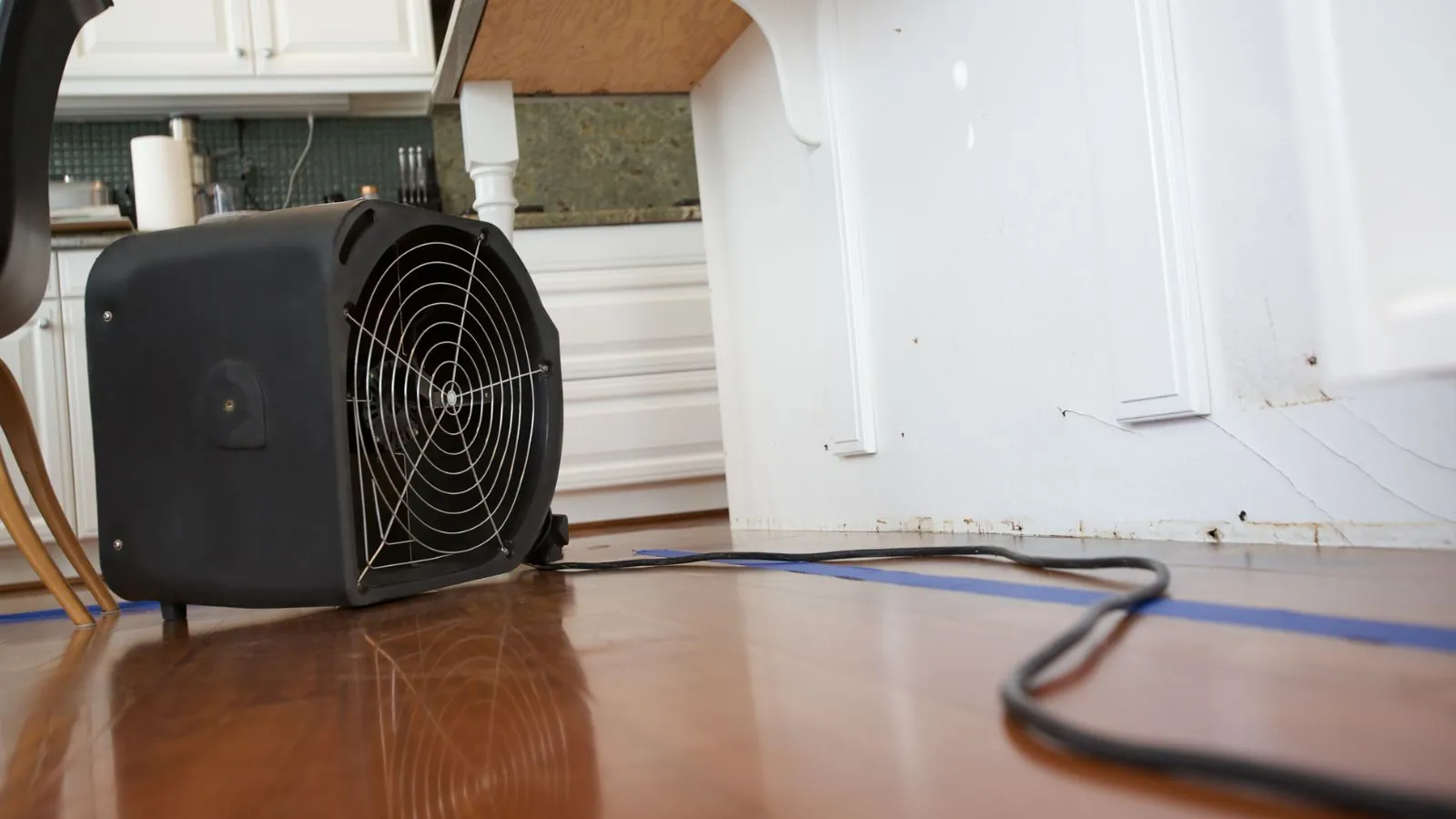
A kitchen holds more water sources in one room than any other space in a house: a sink supply, a drain trap, a disposal, a dishwasher, a refrigerator line and often a pot filler. Kitchen water damage restoration is the drying, cleanup and repair of cabinets, counters, flooring and wall cavities after one of those sources fails.
The cabinet boxes are the main problem, because particleboard swells and does not recover. If the failure was a machine rather than the plumbing, the same work is described on appliance leak water damage.
Where kitchen water damage begins
The sink base is the most common starting point. A compression nut on the supply stop loosens, a trap joint seeps, or a disposal seal wears out, and water drips onto the cabinet floor where nobody looks. The cabinet floor swells first, then the toe kick, then the subfloor below it.
Other sources sit further from the sink. A refrigerator line can leak behind a wall of cabinets, a dishwasher inlet can weep under the counter, and a pot filler feeds a pipe inside the backsplash wall. Each puts water in a different cavity, so the first visit is spent finding which one it is.
A burst pipe under the sink
One call type shows up again and again. A supply line under the kitchen sink lets go while the family is out, and by the time anyone gets home the cabinet is full, the floor is flooded and water is running into the dining room. That is a pressurized failure, and the first move is closing the main, as laid out on burst pipe water damage.
After the main is closed, our crews extract standing water, pull the cabinet contents out and open the toe kick to check the cavity. The cabinet doors and shelves are laid out to dry flat, because warped doors rarely straighten once they sit stacked and wet.
Cabinet floor wet or swollen?
Call (732) 352-9660 and tell us what the cabinets are made of, and we will tell you whether they can dry in place.
Cabinet materials: save, dry or replace
Not every cabinet fails the same way. Solid wood and plywood boxes tolerate a clean-water soak and often dry in place. Particleboard and MDF absorb water like a sponge, swell at the edges and lose the screw holding strength that keeps the box square.
| Cabinet material | Response to water | Usual outcome | What we check |
|---|---|---|---|
| Solid wood face frame | Stains, may cup if soaked for days | Dry in place | Moisture content in frame stiles |
| Plywood box | Edges swell, glue lines hold longer | Often dried and kept | Bottom panel and back edge |
| Particleboard box | Swells and crumbles at screw points | Usually replaced if soaked | Cabinet floor and side panels |
| MDF doors and shelves | Swell, bubble laminate, edges flake | Replaced when swollen | Door edges and shelf ends |
| Laminate or thermofoil finish | Peels at seams when wet behind | Depends on the substrate | Seam adhesion and edge sealing |
If the box is intact but the finish is stained, repainting or refacing may cost less than a full replacement. We list the choice and the trade-off before any cabinet is removed.
Hidden moisture behind the kitchen wall
Wet drywall behind cabinets can hide a long time. Signs include paint that bubbles above the countertop, a faint sour smell in the sink base, a soft spot in the baseboard next to the dishwasher, or a gap where the laminate countertop edge has started to lift.
A moisture meter pressed on the wall gives a reading in seconds, and a thermal imaging camera shows the damp pattern across the whole wall. When the readings stay high, the lower sections of drywall come out and the cavity dries with air movers, as described on wall and drywall water damage repair.
Flooring under the kitchen cabinets
Water that gets through the cabinet floor lands on the subfloor, usually plywood or OSB. When the finished floor runs under the cabinet boxes, the boxes sit on top of it and trap moisture beneath them. When the floor stops at the cabinet edge, water has a direct path to the subfloor.
We drill small holes in the toe kick to feed dry air under the boxes and set a dehumidifier in the room. Tile and sheet vinyl dry quickly. Hardwood and engineered planks take longer, and readings from the boards decide whether they stay.
What to do when the kitchen floods and how it dries without a gut job
A kitchen does not have to be torn out to dry. The sequence below keeps the cabinets and counters where they are whenever the materials allow.
Extract and empty
An extraction unit pulls standing water off the floor, and contents come out of the base cabinets so they can be photographed and inventoried.
Map the moisture
Moisture meters and a thermal camera mark every wet cabinet, wall section and floor zone so the drying equipment goes where it will work.
Open the cavities
Toe kicks come off and small holes go through the cabinet back so warm dry air can move through the voids.
Dry with air movers and an LGR dehumidifier
Equipment runs for several days under ANSI/IICRC S500 practice, and readings are taken each visit.
Decide on repair
Once the materials are dry, we list what to keep, resurface or replace, so you can compare it with your insurer's estimate.
What drives the cost of a kitchen water loss
A leak in a galley kitchen and a leak under an island with a farmhouse sink are different jobs. The factors below set the scope, and the price is explained before work starts.
- Water category: a clean supply line is Category 1, while dishwasher or disposal drain water leans toward Category 2.
- Affected square footage: cabinet runs, floor area and wall length each count separately.
- Cabinet and flooring materials: particleboard and MDF often have to be replaced, while plywood and tile often can be dried.
- Drying days and equipment: a kitchen with an island needs more air movers than a single wall of cabinets.
- Rebuild scope: countertop removal, cabinet replacement, drywall and paint are priced apart from drying.
Sudden and accidental water damage is often covered, while a drip left alone for months often is not. Check your policy or ask your insurer. For a real number on your kitchen, call (732) 352-9660.
Rebuilding a kitchen in Marlboro
The Census Bureau's ACS 2020 to 2024 estimate puts the median value of owner-occupied homes in Marlboro at $701,200, and kitchens are among the costliest rooms to rebuild. Photograph the cabinets before anything is removed, since your adjuster will want to compare the original with the claim.
The township Construction Division handles permits for remodeling work, and its page says contractors must be registered with the New Jersey Division of Consumer Affairs. Ask to see the card. For homes on the Eatontown side, a nearby crew in Eatontown is part of the same dispatch.
Kitchen water damage questions answered
Often, yes, when the box is plywood or solid wood and the water was clean. Particleboard that has swollen and crumbled at the edges usually has to be replaced. We read moisture content in each cabinet and tell you which ones to keep, so you are not replacing a whole run of cabinets when only two boxes failed.
Usually not. Most drying goes through the toe kick and the open cabinet backs. A countertop comes off only if the substrate under it is wet or if it is tied to a wall that needs to open. Granite and quartz are heavy, so removing them is a last resort.
A small clean-water leak often dries in three to five days. Cabinet boxes and subfloor under them take longest. We check readings each visit and remove equipment only when the wood matches a dry reference from another part of the house.
A sudden leak, such as a supply line that breaks, is often covered, while a slow drip over months is often treated as maintenance. Photograph the cabinet and keep the failed part. Check your policy or ask your insurer about coverage and your deductible.
A musty smell means moisture has been there, and mold needs moisture. Only testing can say whether mold is present. If it is, remediation follows ANSI/IICRC S520, and health questions belong to a physician. Fixing the leak and drying the cabinet are the first steps.
Close the shutoff nearest the leak. If you cannot tell which fixture it is, close the main water valve. A kitchen also has electrical outlets at counter height, so if water reaches one, stay out and call 911 or the utility before calling us.
Get the kitchen drying, not demolished
Call (732) 352-9660 and a crew will plan the dry-out around your cabinets and counters.